

Calcium deficiency in crops is a significant issue affecting plant growth and yield. It manifests as disorders like tipburn in lettuce and blossom-end rot in tomatoes. These disorders are often caused by the plant's inability to translocate adequate calcium to affected parts, rather than a lack of calcium in the soil.
We are investigating various fertilization strategies to enhance calcium (Ca) supply to the fruits of fruit trees such as avocado, mango, and apple, as well as crops including pepper, tomato, lettuce, and maize. By optimizing these fertilization methods, we aim to address Ca deficiencies that affect fruit quality and crop yield, ensuring healthier growth and better resistance to physiological disorders.
Optimizing Avocado Export Strategies: Leveraging Spectral Technology and Mineral Composition Analysis for Enhanced Decision Support Algorithms
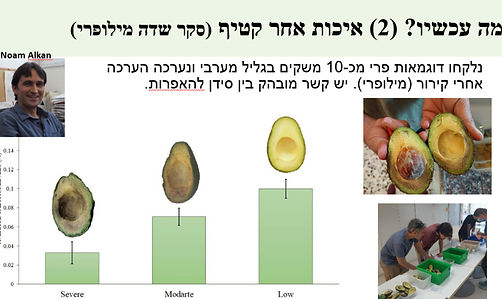
Israeli avocado exports, particularly the Hass variety, are economically important but face challenges from storage defects like internal-grey-pulp (IGP) and decay, making much of the produce unmarketable. These disorders are linked to fruit mineral content, specifically a low calcium (Ca) to nitrogen (N) ratio. Traditional methods for analyzing N and Ca are costly and impractical for large-scale use. This study employs advanced chemometric mineral diagnostics to understand the relationship between mineral composition and postharvest disorders, with a focus on developing rapid and affordable spectral technologies for detecting N, Ca, and fruit maturity.
The project involves field surveys in key avocado-producing regions, spectral analysis of fruit composition, and predictive models for identifying storage disorder risks. It also explores environmental factors affecting avocado mineral content and storage capacity. Collaborating with industry partners, the research aims to reduce economic losses and food waste while boosting the competitiveness of Israeli avocado exports. By providing data-driven decision-making tools, the project seeks to revolutionize avocado farming and promote sustainable practices in fresh produce marketing.
Accurate Fertigation with Polyphosphate to Elevate Fruit Ca, Fruit Quality, and Shelf Life of Different Fruits
Low calcium (Ca) supply to fruits leads to significant yield losses in many fruit trees, as Ca is essential for proper fruit development and shelf life due to its role in the cell wall. Previous research demonstrated that polyphosphates (polyP) are effective Ca chelators, and it is hypothesized that continuous polyP application can improve Ca availability to plants. However, the chain length of polyP is critical, as chelatingaffinity varies. Building on prior studies in vegetables, this research aims to test the optimized polyP form in apple, mango, and avocado, which suffer from physiological disorders due to limited Ca supply,causing potential yield losses of up to 20%
.
Fertigation with Polyphosphates to Diminish Calcium-Related Disorders in Vegetables Grown in a Hot Environment
Physiological defects (non-pathogenic) are accelerated under conditions of heat and drought, primarily due to limited calcium supply. The most well-known defect is blossom-end rot, though various fruits and vegetables commonly suffer from physiological defects, causing significant damage to agricultural produce. In extreme heat, any non-woody part of the plant is vulnerable to defects caused by calcium insufficiency (not deficiency). In preliminary experiments, it was found that polyphosphate fertilizers act as excellent calcium chelators, depending on the length of the phosphate chain. Accordingly, fertilization with polyphosphate increased calcium uptake in lettuce, celery, and tomato, reducing the severity of defects. This research is to further investigate the mechanism by which polyphosphate enhances calcium availability to develop a more effective fertilizer, followed by field testing on various species prone to physiological defects.
Effect of Environmental Conditions and Mineral Availability on the Development of Defects on Potato Peels
Potato cultivation is expanding globally, with Israel growing about 150,000 dunams yearly, largely in the Negev, and exporting over 40%. European buyers are sensitive to skin blemishes on potatoes, especially in sensitive varieties like Vivaldi and Annabelle, leading to annual losses of 50-60 million shekels. Calcium is essential for tuber quality, as it strengthens cell walls, but it is limited in tubers due to low transpiration in humid, soil-covered conditions. Studies in Israel and the U.S. show that calcium supplementation reduces blemishes, suggesting soil minerals directly impact tuber skin.
Recent irrigation changes in Israel, using desalinated and treated wastewater with lower calcium and magnesium levels, may reduce crop quality, especially in sandy soils with low mineral availability. Long-term monitoring has shown declines in magnesium since desalinated water was introduced, which could worsen potato skin blemishes. Current practices do not include mineral supplementation in field crops, but addressing calcium and magnesium deficiencies may be essential to maintain export quality.
The research focuses on understanding how nutrient management, particularly calcium and magnesium supplementation, affects the quality of potatoes grown in Israel’s Negev region. he study aims to determine whether supplementing with calcium and magnesium could improve tuber resilience, reduce skin defects, and maintain quality.


_edited_edited.jpg)
_edited_edited.jpg)